Every April, the design world descends on Milan for Salone del Mobile — the single most important event on the furniture and interiors calendar. With over 1,900 exhibitors from 32 countries and more than 316,000 visitors, the 2026 edition didn’t disappoint. It reaffirmed Milan as the place where the next chapter of interior design gets written.
But beyond the spectacle, what actually matters? What trends are worth watching — not as passing headlines, but as real shifts that will influence how homes and commercial spaces are designed over the coming years?
After walking the fair and studying the collections, we identified three movements that stood out — not because they were the loudest, but because they showed up consistently, across brands, price points, and typologies. Here’s our take on Salone del Mobile 2026 trends.
1. Lacquer Is Back — But Not the Way You Remember It
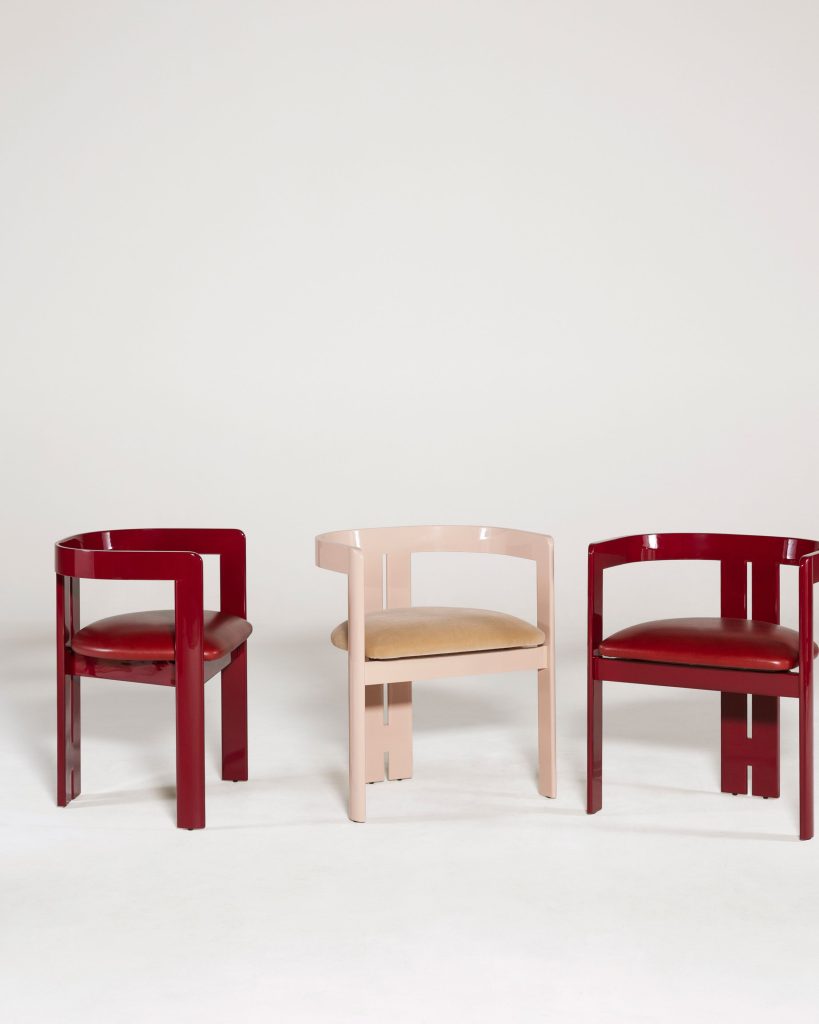
High-gloss lacquer finishes were everywhere at this year’s Salone — on tables, chairs, cabinet fronts, and even sofa backs. But this isn’t the cold, black-and-white lacquer of the 1980s. Lacquer 2.0 is warmer, softer, and showing up in unexpected places.
What’s different this time
The biggest shift is colour. The palette has moved dramatically toward warm browns, mint greens, olive, pale blue, and muted neutrals — what Livingetc described as “a moment of glamour and eye-catching intrigue” without the retro connotation. The gloss is there, but it feels contemporary and inviting rather than stark.
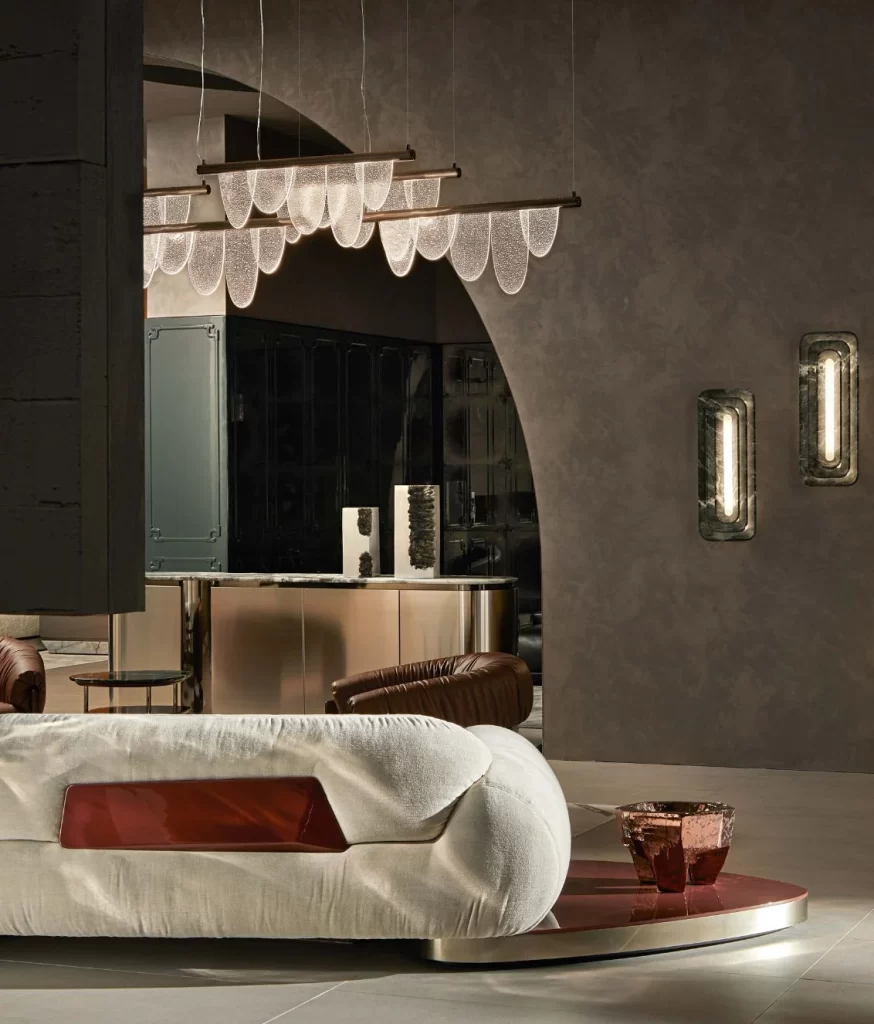
The second shift is where lacquer is appearing. It’s no longer confined to case goods and dining tables. Wallpaper\ led their 2026 trend report with the observation that lacquer is now “infiltrating soft furnishings” — glossy structural shells wrapping around accent chairs and sofa backs. Visionnaire’s Baton Rouge sofa* by Mauro Lipparini was one of the headline pieces: a fully upholstered sofa with a lacquered structural frame that blurs the line between hard and soft.
Brands to watch
- Tacchini — showcased a dedicated Lacquer Collection with pieces spanning seating and tables
- Laurameroni — introduced eleven new lacquer finishes drawn from a botanical chromatic study they called Notes for a Herbarium, perhaps the most conceptually ambitious take on the trend
- Visionnaire — the Baton Rouge sofa by Mauro Lipparini, where lacquer meets upholstery
- Pedrali, Calligaris, Fratelli Boffi — all presented lacquer-forward pieces across different price ranges
Why it matters for interiors
Lacquer adds a layer of visual depth and tactile contrast to any space. A lacquered side table against a linen sofa. A glossy console in an otherwise matte, organic room. It’s a way to introduce a controlled moment of glamour without tipping into excess — and the new colour palette makes it far easier to integrate into the warm, natural aesthetics that dominate Dubai interiors right now.
Our take: Don’t think of lacquer as a statement piece. Think of it as a punctuation mark — one high-gloss element that elevates an entire room.
2. Textured Glass: Furniture You Want to Touch
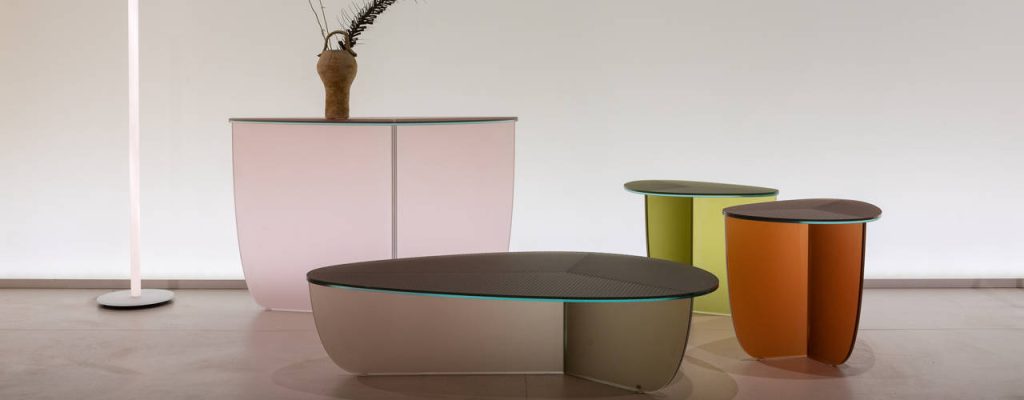
Glass has always had a place in furniture — coffee tables, shelving, display cabinets. But in 2026, the approach to glass has fundamentally changed. It’s no longer about transparency. It’s about texture, colour, and tactility.
The move is from glass as a visual material to glass as a sensory one. Pieces that invite you to run your hand across the surface. Tops that catch light differently depending on the angle. Colours that shift from clear to amber to deep bronze.
Key collections
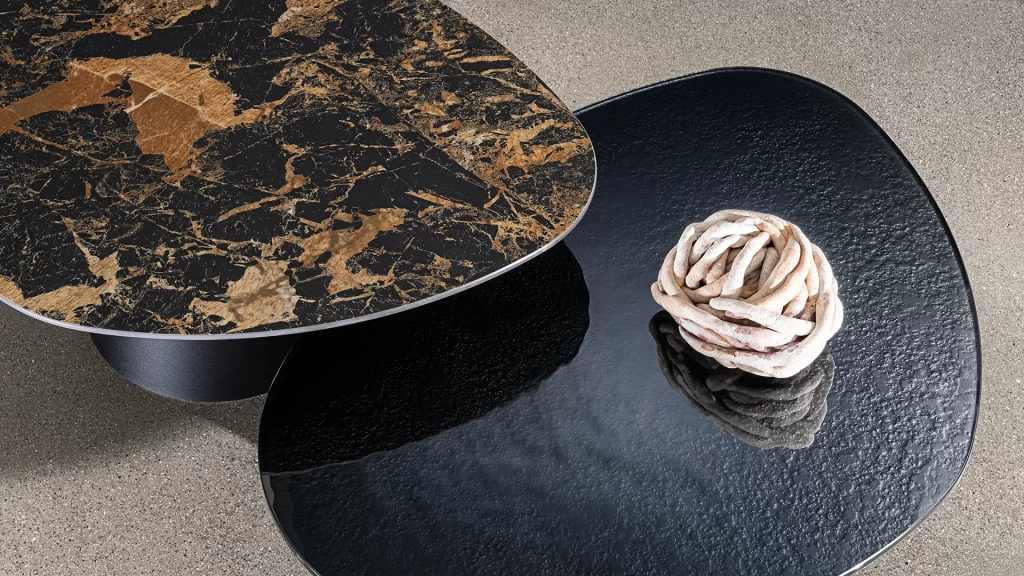
- Sovet’s Totem Drop — a coffee table with an organic, teardrop-shaped top available in Materia glass, wood, and ceramic. The glass version breaks with traditional geometric rigidity, introducing what Sovet describes as “an organic feature that defies conventional table forms.” See it here.
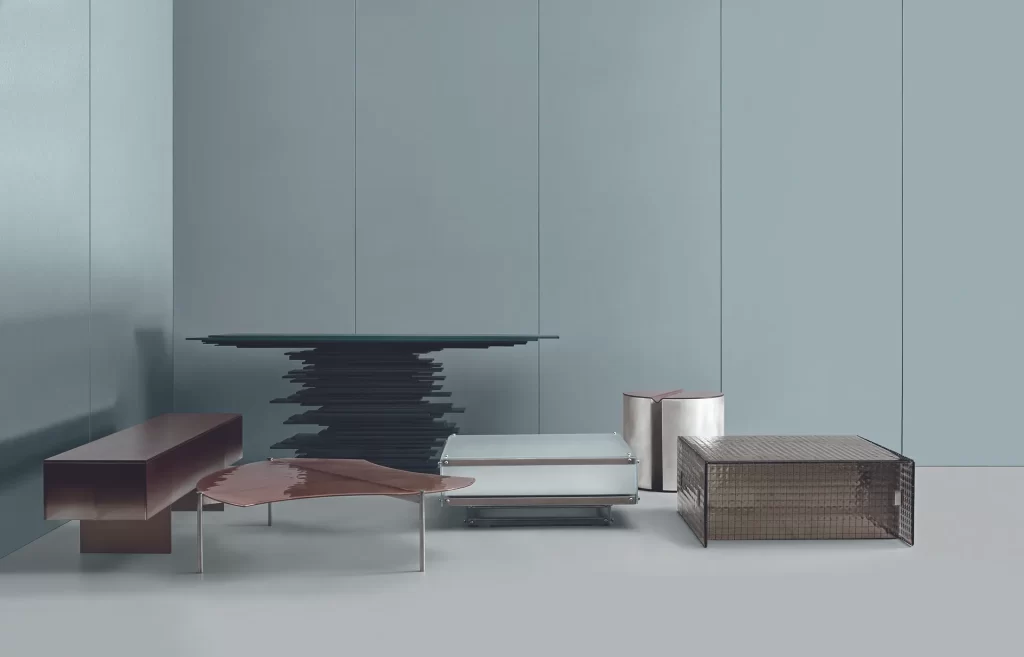
- Gallotti & Radice’s “Glass Tales” — celebrating 70 years, they commissioned a series of designers to push glass to its creative limits. The results include amethyst fused glass on patinated bronze by Estudio Persona, hand-shaded gradient tempered glass by Shibata, thick panels fading from black to transparent by Shodeinde, and crackled fused glass with aluminium-leaf finishes by Cameranesi Sgroi
- Glas Italia’s Akur collection by Hlynur Atlason — another standout in body-tinted and textured glass
The bigger picture
This isn’t a one-brand moment. Pilkington’s post-Salone analysis confirmed a wider material shift toward body-tinted glass in grey and bronze, coloured glass, and decorative finishes across the industry. Glass is being treated with the same creative ambition that used to be reserved for wood, stone, and metal.
Why it matters for interiors
Textured glass adds a dimension that flat surfaces can’t. A textured glass coffee table catches afternoon light in a way that transforms a living room. A coloured glass partition separates zones in an open-plan apartment without closing off sight lines. It’s a material that rewards attention — and in a market like Dubai, where natural light is abundant, glass becomes even more expressive.
Our take: Glass is having its marble moment. Expect to see it move from occasional accent to centrepiece — especially in living rooms and dining areas.
3. Soft Curves: Furniture That Holds You
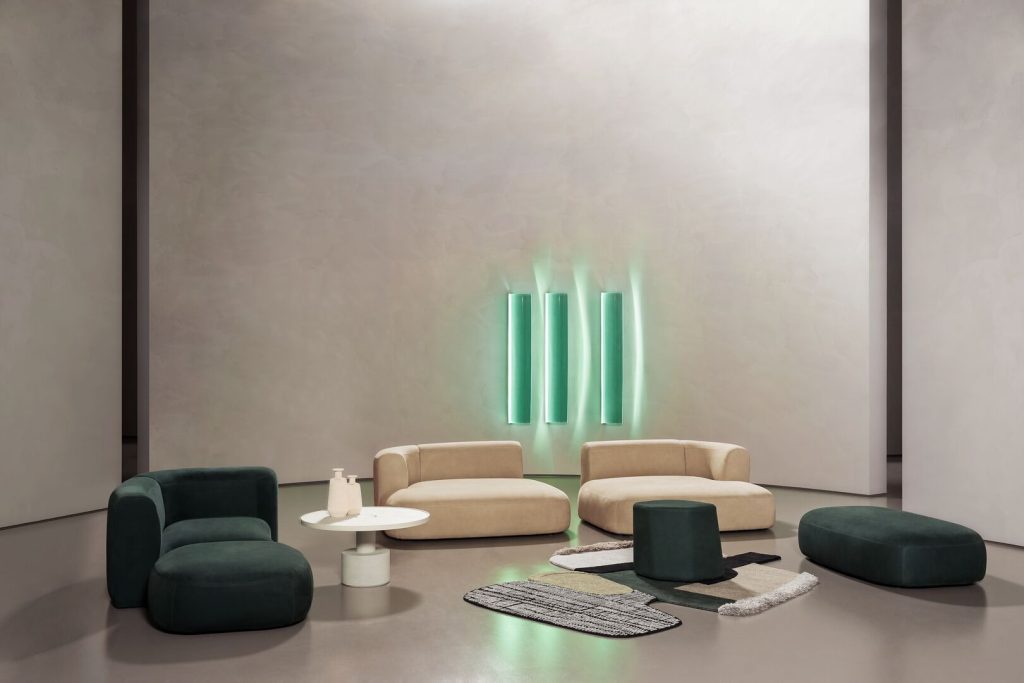
If there’s one visual trend that dominated Salone 2026, it’s this: sharp edges are out, and soft, enveloping curves are in. From modular sofas to dining chairs to outdoor collections, rounded silhouettes were everywhere — and the underlying message is about more than aesthetics.
The deeper story
The curve isn’t new, but the intent behind it has evolved. Surface Magazine put it best: “Large, curved sectionals dominated the booths of Dedon, Minotti, Nii, and Tacchini… referencing another midcentury relic — the conversation pit.” The design isn’t just about looking soft — it’s about creating spaces that draw people together.
2Modern reinforced the same thesis: “Curved or soft angles and low profiles create immersive environments that invite lounging, listening, and lingering.”
Standout pieces
- Ethimo’s Loop sofa by Elena Salmistraro — a self-supporting outdoor three-seater that relies on technical padding instead of a visible frame, with an enveloping shape designed for open social use from every side. See it here.
- Baxter’s Clara modular sofa by Christophe Delcourt — organic seating built from concave and convex elements, paired with the Beki pebble-shaped ottomans. Salone’s own editorial team flagged this as one of the most innovative upholstery projects of the fair
- Piet Boon’s Rounded Stillness PAM series — a full system of modular sofas, ottomans, daybeds, coffee tables, and side tables, all sharing the same curved language. This shows the trend extending beyond hero pieces into complete living environments
- Patricia Urquiola’s Ardy sofa for Cassina — voluminous, soft shapes with visible stitching that creates a graphic duvet-like texture
- Acerbis Palla armchair — a 1960s design reinterpreted in new comfort-driven materials by Francesco Meda and David Lopez Quincoces
Why it matters for interiors
Curves change how a room feels. A rounded sofa softens an angular living room. An organic-shaped dining table encourages conversation. In villas with large open spaces, curved furniture creates intimate zones without walls. In apartments, a well-chosen curved piece can make a compact living room feel more generous and inviting.
The trend also extends to outdoor furniture — which is particularly relevant in the UAE, where outdoor living is a major part of the residential experience for at least half the year.
Our take: This isn’t about buying one curvy chair. It’s about rethinking how seating arrangements create social energy. The conversation pit is coming back — and it looks incredible.
What These Three Trends Have in Common
Look at lacquer, textured glass, and soft curves together, and a clear theme emerges: design in 2026 is about sensory experience.
Each of these trends asks you to engage with furniture beyond the visual. Touch a lacquered surface. Feel the weight of a textured glass top. Sink into a sofa that wraps around you. Milan is telling us that the best interiors aren’t just beautiful to look at — they’re beautiful to be in.
This aligns perfectly with the broader shift toward organic, tactile, warm design that we’re seeing in Dubai and across the region. The gold-and-black era is behind us. What’s ahead is richer, more layered, and ultimately more human.
Final Thoughts
Salone del Mobile remains the compass for where interior design is heading. The 2026 edition confirmed that the industry is moving toward warmth, texture, and emotional connection — away from cold minimalism, away from decoration for decoration’s sake, and toward spaces that genuinely enhance how people live.
Whether you’re furnishing a home, refreshing a space, or simply curious about what’s next — these three trends are worth watching. They’re not fads. They’re the building blocks of how interiors will look and feel for years to come.
Inspired by what you’ve read? At BE4 Design, we bring Milan’s latest thinking directly into UAE homes. Let’s talk about your next project.