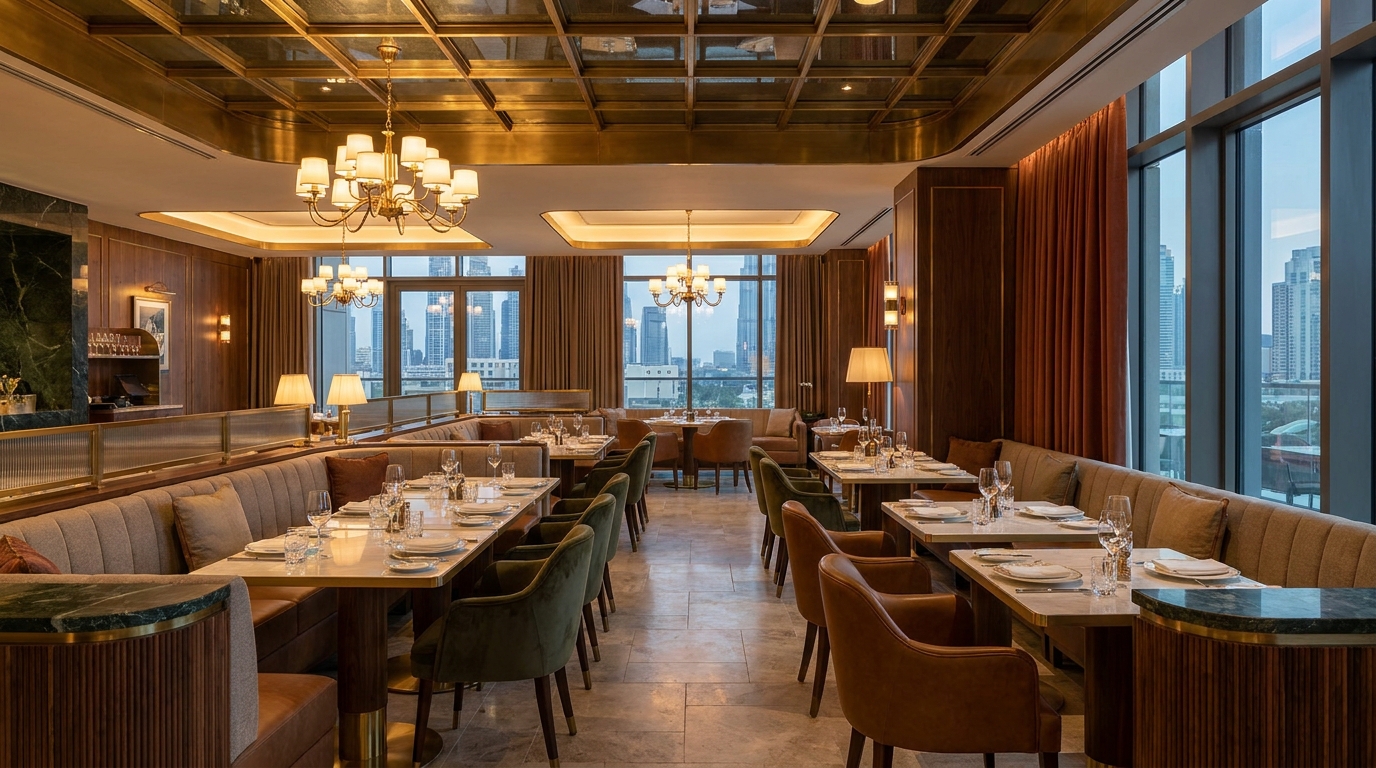
Furniture suppliers rarely fail at the quote. They fail in month four, when a specified chair is discontinued, a container arrives damaged or the installation crew is committed to another site.
This guide is for the person building the bidder list on a hotel or restaurant FF&E package: the owner’s representative, the project manager, the procurement lead, or the designer who has been handed sourcing. It sets out eight checks to put to hotel furniture suppliers in Dubai before they are invited to bid, and what a usable answer sounds like. Contractor procurement teams choosing dealers can run the same list.
Why the usual criteria do not separate suppliers
Reputation, quality and service appear in every company profile, so they cannot rank one supplier against another. Most hotel furniture suppliers in Dubai describe themselves in the same terms, and nobody fails those criteria on paper.
Each of the checks below has an answer that can be written into the quote or the contract and held to later. If a supplier cannot answer one in writing before the bid, treat that as the answer.
The eight checks
Send them as a written questionnaire before the bidder list is final, so every answer arrives in a form that can be compared side by side.
1. Stocked or made to order, and the real lead time for each
This is the biggest single driver of programme risk. Most hotel packages mix the two: some items are held in regional stock, others are produced in Europe after the order is placed. Ask for the split line by line against the BOQ, with a lead time for each that runs from purchase order to delivery on site.
A good answer: a schedule showing which lines are stocked and which are made to order, with production weeks, shipping weeks and clearance for each, plus how progress will be reported. Our own supply runs on weekly production and delivery updates, which is the frequency worth asking for. Our guide to avoiding hospitality furniture delivery delays covers the shipping side in more detail.
2. Who is importer of record, and who clears customs
If the client is expected to act as importer, the quote covers less than it appears to: duty, clearance paperwork and port delays move to the client’s side. UAE customs duty is generally 5% of the cost including insurance and freight, with 5% VAT on top, and clearance usually takes one to two days when the documentation is correct.
A good answer: the supplier names the importing entity, confirms that duty and clearance are in the price, and states who carries the risk while goods sit at the port.
3. What the quote includes and excludes
This is where unit price and landed cost part ways. Ask for an explicit list covering freight, duty, delivery to floor rather than to the loading bay, installation, packaging and waste removal, and storage if the site is not ready on the delivery date.
A good answer: every line marked included or excluded, with a rate for anything excluded. For reference, our supply orders include installation and seven days of free storage in a private warehouse.
4. Discontinuation and substitution
Specified items go out of production mid-project, and the longer the programme, the more likely it becomes. Ask what happens when it does: who sources the equivalent, who submits it for approval, and who carries any cost difference.
A good answer: a defined process. The supplier proposes alternatives matched to the original on dimensions, finish and performance, submits them to the designer for approval, and the contract states who pays if the substitute costs more. The product knowledge this needs is the same as for value engineering, so ask about both in the same conversation.
5. Warranty: length, coverage, and who honours it
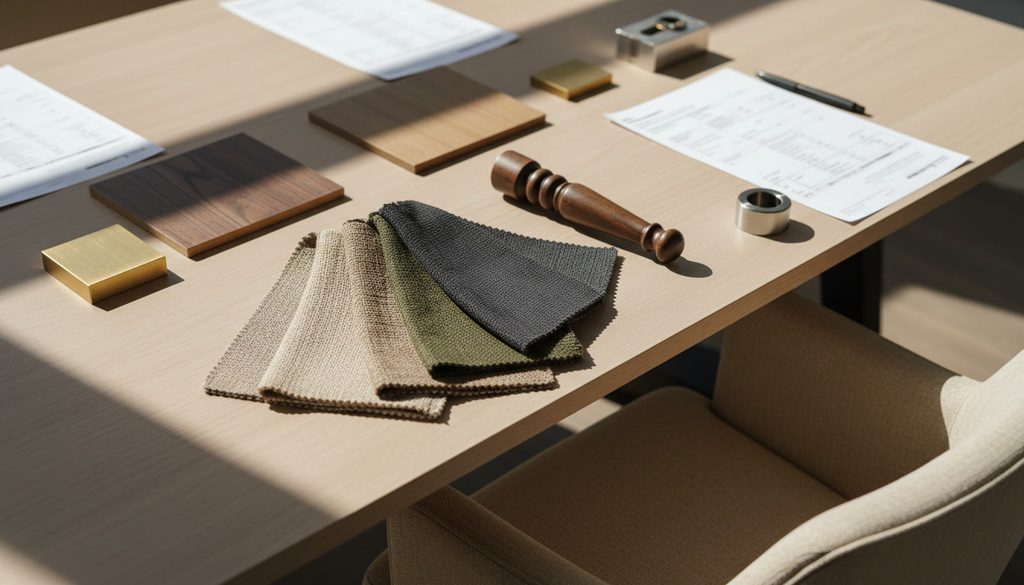
A warranty held by a manufacturer in another country is harder to use than one held by the supplier in front of you. Ask for the length, what it covers across frames, mechanisms, upholstery and finishes, what voids it under commercial use, and which company in the UAE you call when something fails.
A good answer: the terms in writing, with the local party responsible named. Our supply carries a guarantee of three years or more. Ask every bidder for the warranty document itself rather than a sentence in the proposal.
6. Who installs, and whether they are insured
Ask whether installation is carried out by the supplier’s own team or subcontracted, who supervises on site, and whether the crew’s insurance meets the main contractor’s site requirements. Ask too how the installation will be sequenced around the other trades, since furniture usually goes in last and absorbs every delay ahead of it. Installation left out of the quote tends to come back later as a variation.
A good answer: the installing party named, an insurance certificate available on request, and installation priced as its own line.
7. Damage in transit
Ask who bears the loss when goods arrive damaged, how damage is recorded at delivery, and how long a replacement takes. A replacement that takes ten weeks is a different answer from one that takes ten days, and on a hotel opening the gap is measured in rooms that cannot be sold.
A good answer: the supplier carries transit risk until handover, inspects on delivery, and gives a replacement lead time for each made-to-order line.
8. Brand authorisation and capacity
Ask whether the supplier is an authorised dealer for every brand in its quote, and request the authorisation letters. A reseller without authorisation may be unable to order spare parts, match finishes on a later batch, or pass on the manufacturer’s warranty. Then ask about capacity: how many packages of this size the supplier is running now, and who will manage yours.
A good answer: a letter for each brand, a named project manager, and a straight account of the current workload.

How the answers change the bid comparison
When hotel furniture suppliers in Dubai are compared at bid levelling, the basis is landed cost: product, freight, duty, installation, lead time, warranty and risk. The lowest unit price regularly loses at this stage, because the exclusions from check 3 and the risks from checks 2, 4 and 7 are priced back in.
Put the eight answers into the levelling sheet as columns. On imported goods, duty alone adds 5% of the cost including insurance and freight before a single chair is installed. A bid with a low unit price, customs on the client’s side, installation excluded and a manufacturer-only warranty carries four costs the price does not show, and each one has to be given a figure before the bids can be compared fairly.
If the boundary of the package itself is unclear, our FF&E and OS&E guide sets out where the line usually falls.
If you are shortlisting hotel furniture suppliers in Dubai for an FF&E package, our furniture supply page sets out how we quote, deliver and install.